If a hidden leak drove your water bill up, Pinellas County has real relief programs, and most homeowners never file for them. Everything below comes straight from the county’s own pages at pinellas.gov, with links to the actual forms.
The Leak Adjustment: a Credit on Your Water Bill
Pinellas County Utilities will review your bill for an adjustment after a water leak on your property has been repaired. In the county’s words: “If you repaired a water leak on your property, you may qualify for a leak adjustment to your water bill.” The credit applies to the water the leak wasted. There are two ways to document it:
- A licensed plumber’s invoice showing what was repaired, attached to the county’s Leak Adjustment Request.
- No invoice? Complete the county’s Statement of Repaired Leak, have it notarized, and email it to ut***************@******as.gov.
Either way, the county wants three things in the paperwork: a description of the repair, the repair date, and the repair location. The county reviews each request individually, so amounts are not published or guaranteed. Customer service is at (727) 464-4000 if you want to ask about your specific bill.
The Sewer Line Rebate: Up to $3,500
Separate program, bigger numbers. Pinellas County’s Private Sewer Lateral Rebate Program pays 100% up to $350 for an inspection of your private sewer line, and 50% up to $3,500 toward repair or replacement. It is for single-family homes in the Pinellas County Utilities sanitary sewer area, the work needs a contractor registered with the county licensing board plus a permit, and you apply within 90 days of the work. If you got a Find & Fix letter in the priority areas of Largo, Seminole, or St. Petersburg, inspection and repairs may be covered at no cost. Questions go to ps*******@******as.gov.
One honest note: sewer laterals are drain lines, not the pressurized water lines we find leaks in. We do not do sewer work. But high water bills and wet spots get investigated together, so both programs belong in one guide.
On a City Utility Instead of the County?
Not everyone in Pinellas County is a Pinellas County Utilities customer. St. Petersburg and Clearwater run their own water utilities, and several other cities, including Dunedin, Oldsmar, Pinellas Park, and Tarpon Springs, bill through their own systems. Check who sends your water bill. If it is a city, call the number on the bill and ask for their “leak adjustment” policy. That is the phrase billing departments recognize, and many cities have their own version of the county’s program.
How Much Water a Hidden Leak Actually Wastes
The reason these programs exist: leaks waste a staggering amount of treated water. The EPA’s WaterSense program estimates the average household’s leaks waste nearly 10,000 gallons a year, and about one home in ten has leaks wasting 90 gallons or more every day. On a Pinellas water bill, that adds up fast:
| Leak type | Typical waste | Water lost per month |
|---|---|---|
| Running toilet flapper | ~200 gallons a day | ~6,000 gallons |
| Small hidden leak (EPA’s 1-in-10 homes) | 90+ gallons a day | 2,700+ gallons |
| Pinhole in a pressurized line | 250+ gallons a day | 7,500+ gallons |
| Slab or underground line failure | often far more | can double a bill or worse |
The Documentation Checklist
Adjustment requests live or die on paperwork. The county asks for a description of the repair, the repair date, and the repair location. Before you file, gather:
- Your water bills from before the leak and during it, showing the usage jump
- The plumber’s invoice for the repair, or the notarized Statement of Repaired Leak if you fixed it yourself
- The leak detection report showing where the leak was and when it was found
- Photos of the leak location before and after repair
File promptly after the repair. Utilities look for a clear story: bill spiked, leak found, leak fixed, usage returned to normal.
Why the Paperwork Is Easy With Us
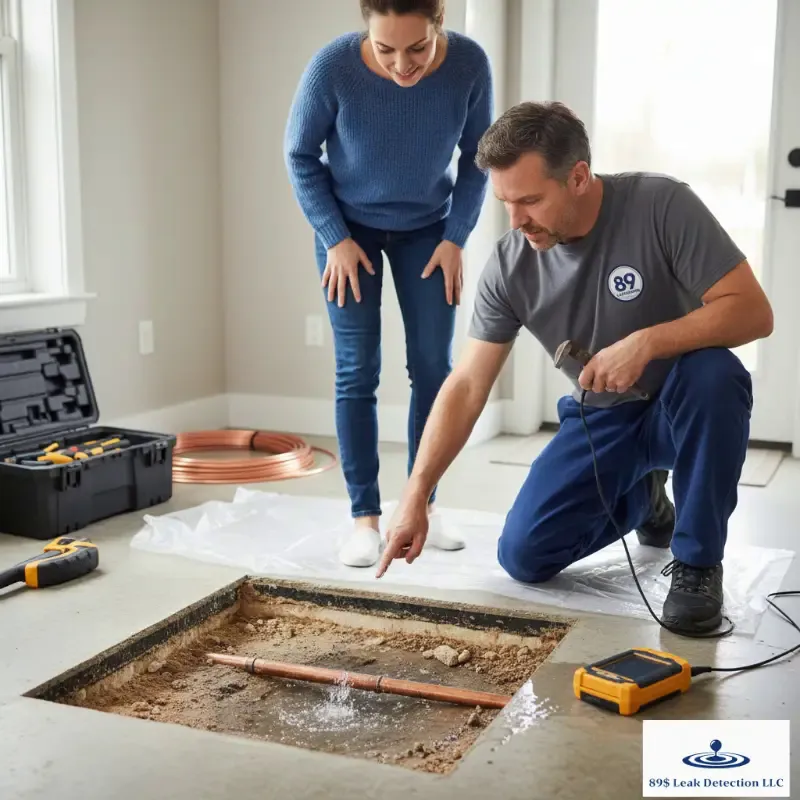
Every 89 Leak Detection visit ends with the leak location marked, photos, and a written summary of what we found, exactly the description, date, and location the county’s forms ask for. Our detection pricing is simple too: $89 service call, $89 per hour, $178 total for the first hour, never more than $350.
Not Sure If You Have a Leak?
Try the 60-second meter test. Turn off every faucet and fixture, then watch your water meter. If the dial keeps moving, water is going somewhere it should not be. A high water bill and a moving meter together almost always mean a real leak, often a slab leak, an underground hot water line, or a yard line failure.
Common Questions
Does Pinellas County reimburse the cost of leak detection?
The county’s published leak adjustment is a credit for wasted water on your bill after a documented repair. No reimbursement for detection costs is listed on the county’s pages. If that matters to your situation, ask customer service directly at (727) 464-4000.
What if I fixed the leak myself and have no plumber invoice?
The county accepts a notarized Statement of Repaired Leak instead of an invoice. Fill out their form, get it notarized, and email it to ut***************@******as.gov.
My water comes from a city, not the county. Do I get anything?
Often yes. St. Petersburg, Clearwater, Dunedin, and other Pinellas cities run their own utilities, and many have leak adjustment policies for documented repairs. Call the number on your bill and ask.
How big is the sewer lateral rebate?
Per the county’s program page: 100% up to $350 for an inspection, and 50% up to $3,500 for repair, replacement, or rehabilitation of a private sewer lateral, with contractor licensing, permit, and 90-day application requirements.
How much water does a hidden leak waste?
The EPA estimates average household leaks waste nearly 10,000 gallons a year, and about one home in ten has leaks wasting 90 gallons or more per day. A slab or underground line failure can waste far more and can double a water bill.
Call (727) 239-0089 any time. We find most leaks in one visit, and you leave with the exact documentation the county’s forms ask for.